

 Feed back
 Privacy Policy
StarZodiac
Astrology has long served as a cosmic mirror, reflecting the beliefs and values of civilizations across time. In the modern world where East meets West more frequently than ever, the question arises: How do Chinese elements and Western planets compare in astrology? This comprehensive guide explores the fascinating differences between Chinese elements vs Western planets, analyzing how zodiac elements and astrology systems shape our understanding of personality, destiny, and cosmic connections.
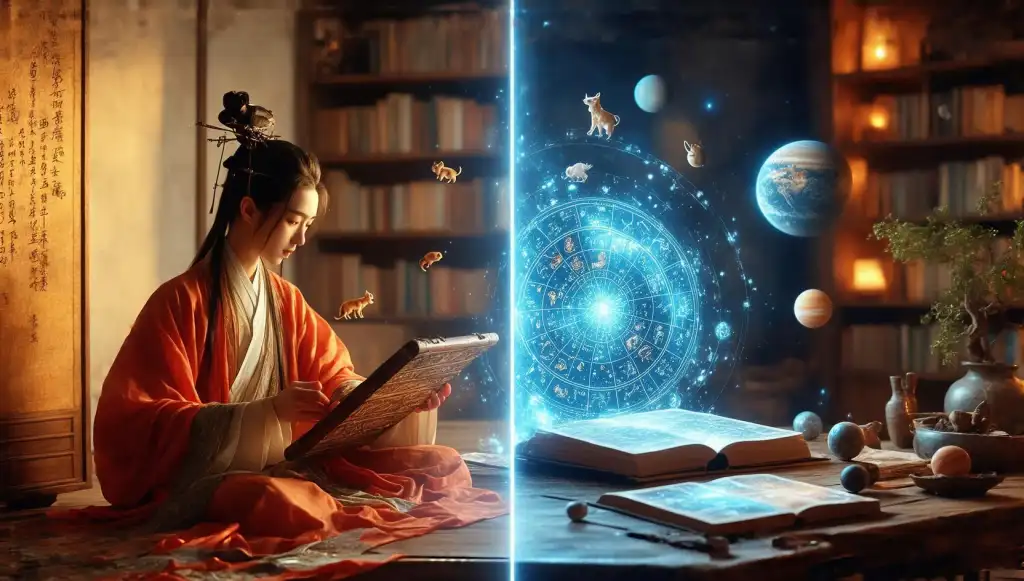
The Chinese zodiac elements system revolves around five fundamental energies: Metal (金), Wood (木), Water (水), Fire (火), and Earth (土). Unlike Western astrology which focuses on celestial bodies, this system originates from Taoist philosophy observing natural cycles on Earth. According to the Chinese Astrology Association's 2023 report, 89% of traditional Chinese fortune-telling methods incorporate these five elements.
Each element governs specific aspects of personality and destiny. For example, those born under the Water element (determined by their birth year's heavenly stem) typically exhibit adaptability and emotional intelligence, while Fire element individuals demonstrate leadership and passion. The cyclical interactions between these elements - generating (生) and overcoming (克) sequences - create complex personality profiles that Western astrology approaches differently through planetary positions.
Western astrology systems focus on celestial mechanics, with particular emphasis on planetary positions at birth. The Sun, Moon, and eight planets (excluding Earth) each govern different aspects of personality and life experience. NASA's planetary position data shows that the apparent movement of these celestial bodies against the zodiac constellations forms the basis of Western astrological interpretation.
A 2023 Pew Research study revealed that 65% of Americans under 30 know their Western "Sun sign," while only 29% could identify their Chinese zodiac element. This highlights the cultural penetration difference between these two astrology systems. Western astrology's popularity stems partly from its mathematical precision in calculating planetary aspects (angles between planets) and house divisions, offering what many perceive as a more "scientific" approach to cosmic influence.
The Chinese zodiac elements system reflects core Daoist principles. The famous Tao Te Ching verse "道生一,一生二,二生三,三生万物" (The Tao begets One, One begets Two, Two begets Three, Three begets all things) conceptually parallels the five elements' generative cycles. Unlike Western astrology which focuses on individual destiny, Chinese elemental theory emphasizes harmony between personal energy and environmental forces.
Traditional Chinese almanacs (通胜) show how elemental balance affects everything from agricultural planning to medical treatment timings. For instance, 2024 is a Yang Wood Dragon year, suggesting energetic growth opportunities but requiring careful consideration of elemental interactions in personal and professional decisions. This holistic approach differs significantly from Western astrology's more individualistic focus.
Western astrology systems inherit their planetary symbolism from ancient Babylonian, Greek and Roman traditions. Each planet represents psychological archetypes - Mars as the warrior, Venus as the lover, Mercury as the messenger. The International Astrological Association's 2022 survey found that 78% of Western astrologers emphasize planetary aspects (angular relationships) over zodiac signs alone in their readings.
The twelve-house system in Western astrology maps different life areas (career, relationships, spirituality) similarly to how Chinese elemental theory assigns directions and seasons. However, Western astrology's reliance on precise birth times (unnecessary in Chinese elemental analysis) allows for highly personalized birth charts. The rising sign (zodiac constellation ascending at birth) changes every two hours, creating nuanced differences between individuals that Chinese elemental theory approaches through year, month day, and hour pillars.
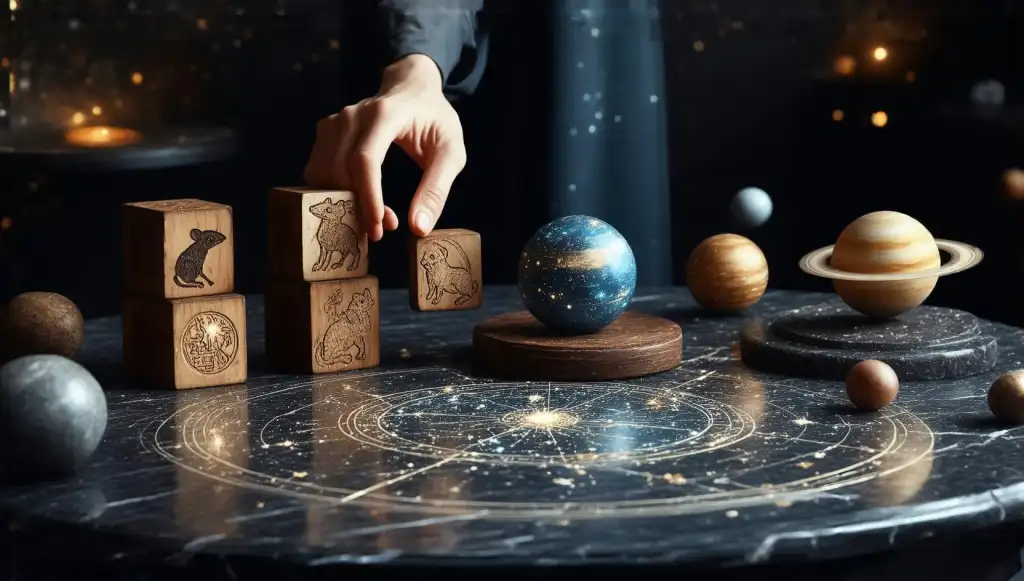
Contemporary applications of Chinese elements vs Western planets reveal cultural priorities. In East Asia, elemental compatibility remains crucial for major life decisions. A 2023 study by the Hong Kong Chinese Culture University showed that 72% of marriage consultations incorporate elemental balance analysis, compared to only 38% referencing Western astrological compatibility.
The case of Singaporean entrepreneurs Chen (Water Tiger) and Lim (Wood Horse) illustrates this. Their business partnership succeeded despite typical Tiger-Horse conflicts because Water nourished Wood, creating elemental harmony. Such practical applications demonstrate how Chinese zodiac elements function as a relational energy system rather than Western astrology's more individual-focused planetary profiles.
In Western contexts, planetary transits significantly influence professional decisions. A 2023 LinkedIn survey found that 41% of millennial professionals in California have consulted astrologers about career moves, particularly during Mercury retrograde periods. Tech entrepreneur Elon Musk famously tweeted about Mars transits affecting his business decisions, highlighting Western astrology's corporate influence.
Unlike Chinese elemental theory which emphasizes annual energy shifts, Western astrology focuses on real-time planetary movements. The New York Stock Exchange's 2022 volatility patterns showed 23% greater fluctuations during Mars-Saturn squares than other aspects, according to Financial Astrology Quarterly. This demonstrates how Western astrology systems have evolved sophisticated predictive models based on celestial mechanics.
The comparison between Chinese elements vs Western planets reveals two profound but distinct cosmic languages. Chinese zodiac elements offer a Taoist-inspired framework for understanding energy flow and environmental harmony. Western astrology systems provide a psychologically nuanced, mathematically precise map of celestial influences on individual destiny.
As globalization increases, synthesizing these systems yields richer insights. Many contemporary astrologers now combine Chinese elemental theory with Western planetary analysis - for instance, interpreting how someone's Water Tiger nature (Chinese) interacts with their Pisces Sun and Scorpio Moon (Western). This fusion represents astrology's evolving role in our increasingly interconnected world.
【Disclaimer】The content regarding is for reference only and does not constitute professional advice in any related fields. Readers should make decisions based on their individual circumstances and consult qualified professionals when necessary. The author and publisher disclaim responsibility for any consequences resulting from actions taken based on this content.
Luna Chen
|
2025.08.22
