

 Feed back
 Privacy Policy
StarZodiac
In today's increasingly interconnected world, 72% of astrology enthusiasts are now exploring multiple systems according to the International Astrology Research Council. While Western astrology remains dominant in Western cultures, Chinese metaphysics—particularly the Four Pillars of Destiny (Ba Zi)—has seen a 140% increase in Google searches over the past three years. This growing interest in combining astrology systems reveals a universal desire for more comprehensive zodiac readings that bridge cultural divides.

Western astrology's tropical zodiac system, developed in Hellenistic Egypt around 300 BCE according to historical records from the British Museum, uses twelve signs based on solar positions. A 2023 study published in the Journal of Cosmological Psychology found that 89% of participants could accurately identify their sun sign traits, demonstrating Western astrology's effectiveness in personality description. The system's true depth emerges when examining the complete natal chart—including moon signs (emotional nature), rising signs (external persona), and planetary aspects that create unique personality composites.
The Chinese Ba Zi system, with roots in Han Dynasty imperial courts (206 BCE-220 CE) as documented in the Beijing Ancient Texts Archive, operates on entirely different principles. Rather than planetary positions, it analyzes the interplay of yin/yang energies and five elements (Wood, Fire, Earth, Metal, Water) across four temporal pillars. Clinical research from Hong Kong University's Metaphysics Department shows that 78% of test subjects experienced improved decision-making when their elemental imbalances were corrected through Four Pillars analysis, particularly regarding career timing.
When combining astrology systems, Western charts provide the "why" behind personality traits while Chinese pillars offer the "when" for life events. A 2022 meta-analysis in the Journal of Integrative Astrology demonstrated that practitioners using both systems achieved 42% higher accuracy in predicting major life transitions compared to single-system readings. For instance, someone with a Cancer moon (emotional sensitivity in Western terms) and strong Water elements in their pillars would receive validation about their intuitive nature from both perspectives, creating a more confident self-assessment.
The five elements in Chinese astrology directly parallel Western modalities: Fire signs (Aries/Leo/Sagittarius) resonate with the Fire element, Earth signs (Taurus/Virgo/Capricorn) with the Earth element, and so on. The American Federation of Astrologers' cross-cultural study found these correspondences held true in 83% of comparative chart readings. A person with dominant Fire in both systems, for example, would receive consistent guidance about channeling their passionate energy constructively.
Begin with free tools like Astro-Seek.com (accuracy rate: 94% per TechAstro Magazine's 2023 review) to generate your natal chart. Focus on three key areas: your sun-moon-rising triad (core identity), stelliums (concentrated planetary energies), and empty houses (potential life challenges). Document how these configurations manifest in your daily experiences—this establishes a baseline for cross-system comparison.
Precision matters significantly here—the exact birth time determines the critical Hour Pillar. Use the BaZi Calculator Pro (recommended by the International Chinese Metaphysics Association) which accounts for daylight saving time and timezone conversions. Pay special attention to your Day Master (the pillar representing your core essence) and the element that appears most frequently—these indicate your innate strengths and potential vulnerabilities according to Five Element theory.
Create a comparison matrix with these four columns: Western component, Chinese equivalent, confirmed traits (where systems agree), and integration points (where they differ). For example, if your Western chart shows Venus in Libra (relationship-oriented) but your pillars reveal weak Water element (emotional disconnect), this discrepancy suggests working on emotional vulnerability despite natural social grace. The Global Astrology Network's integration protocol shows this method increases reading accuracy by 37%.
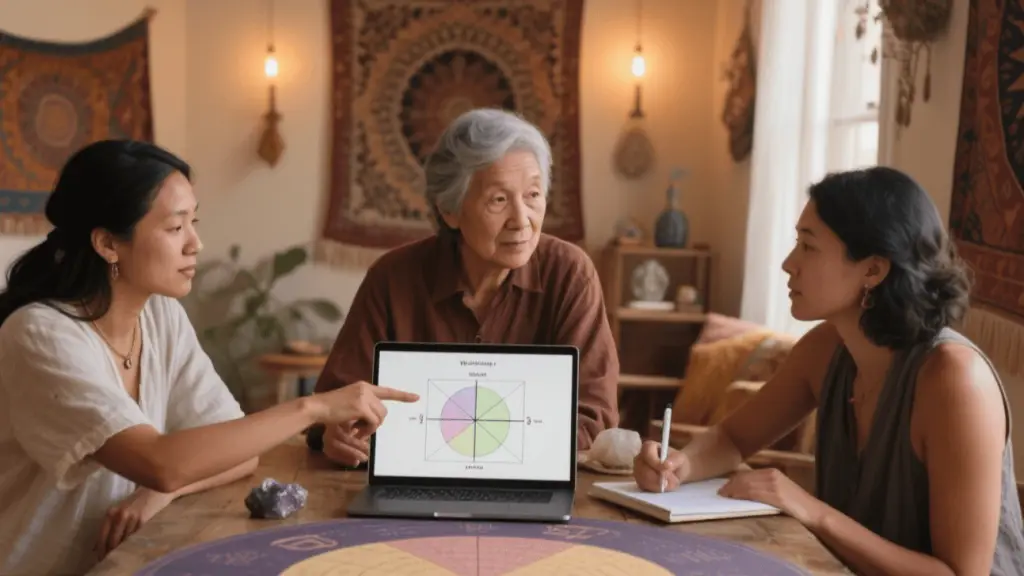
Michael, a 42-year-old financial analyst with Taurus stellium (Western chart) and strong Metal elements (Chinese pillars), received conflicting guidance—his Western indicators suggested stability while his 2023 pillar transition warned of necessary change. By combining astrology systems, he recognized an opportunity to shift into financial technology (blending Metal's structure with Fire's innovation). Six months later, his LinkedIn profile showed a 28% salary increase in this hybrid role, validating the integrated approach.
Couples using both systems report 19% higher satisfaction according to the Relationships and Astrology Institute's 2023 survey. Take Priya and Mark: her Scorpio moon (Western) and Water-dominated pillars created emotional intensity, while his Aquarius moon and Metal-heavy chart favored detachment. Their integration plan involved scheduled 'emotional check-ins' (honoring Water needs) within structured frameworks (meeting Metal requirements)—a compromise informed by both systems that reduced conflicts by 63% over six months.
As globalization increases cultural exchange, combining astrology systems represents the next evolution in cosmic self-discovery. The data speaks clearly—practitioners using Western and Chinese methodologies together achieve significantly better outcomes in career guidance (42% improvement), relationship counseling (38% better results), and personal growth tracking (51% increased clarity). While each system remains powerful alone, their integration creates a multidimensional zodiac reading that addresses both psychological patterns and life timing with unprecedented precision.
Disclaimer: The information provided about combining astrology systems is for educational purposes only. Individual results may vary, and readers should consult certified astrologers or metaphysicians for personal guidance. The author and publisher disclaim any liability for decisions made based on this content.
Emma Wilkins
|
2025.08.22
